
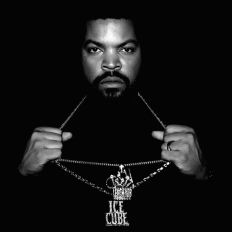
Profile
When Ice Cube left the notorious L.A. rap group N.W.A in 1990, he continued writing hard-hitting gangsta rap songs that pushed buttons in the media as well as among parents, politicians, and police. He also embarked on a successful acting career that by the end of the decade had almost eclipsed his musical output. The son of a strict two-parent home (his mom was a clerk, and dad a groundskeeper at UCLA), South Central L.A. native O'Shea Jackson found success with N.W.A [see entry] after graduating from college in 1988 with a degree in drafting. In 1990 he had a falling out with N.W.A's management and went solo. For his first album, Cube and his group, Da Lench Mob, enlisted Public Enemy's celebrated Bomb Squad production team, whose dense musical collages include artful uses of sampling and turntable manipulation. Released in spring 1990, AmeriKKKa's Most Wanted (#19 pop, #6 R&B, 1990) went gold in 10 days and platinum in three months. A sonically forceful, lyrically vicious album, it juxtaposes a barrage of disparaging terms like "bitch" and "ho" with astute, politically charged observations of ghetto life: gang violence, black-on-black killing, abusive police, poverty, drugs, money, and sex roles. Parents and officials immediately criticized Cube for being a bad role model; Cube countered that that was not his responsibility. Even among rock critics who defended his gangsta rap for its realism, he was censured for the brutal track "You Can't Fade Me," in which the song's protagonist fantasizes aborting his girlfriend's pregnancy with a coat hanger. AmeriKKKa's Most Wanted also introduced Cube's female collaborator, Yo Yo, who on the point-counterpoint track "It's a Man's World" offered a black woman's perspective to counter Cube's male-centric observations. (Ice Cube landed Yo Yo a reported six-figure deal with Atlantic and coproduced her 1991 #5 R&B debut, Make Way for the Motherlode.) For all its unanswered questions and contradictions, AmeriKKKa's Most Wanted is considered a rap classic. With his powerful, rhythmic baritone delivery, Ice Cube has maintained a consistently high standing among critics and fans. Still, after the Kill at Will EP (#34 pop, #5 R&B, 1991), he returned with two of his most controversial songs to date on Death Certificate (#2 pop, #1 R&B, 1991): "Black Korea," wherein he denigrates Korean market owners, and "No Vaseline," in which he antagonistically refers to N.W.A manager Jerry Heller as a "Jew." The songs led to the first condemnation of an artist in the editor's note of the music trade publication Billboard. The album's single, "Steady Mobbin'," reached #67 pop and #30 R&B that year. In December 1992 Ice Cube made history again when The Predator debuted at #1 on both the pop album and R&B charts (it sold 1.5 million within a month of release); the album included "It Was a Good Day" (#15 pop, #7 R&B, 1993), a clever ghetto fantasy where everything goes surprisingly right for 24 hours. Currently #7,487 in the BookedDJ global ranking.